
How to break into ESG consulting? Finding your niche, winning clients and managing workflows
Most people don’t realize this, but the way they approach ESG consulting often puts them at a disadvantage from the very start.
Because the first instinct is usually this: “I just need to find the missing skill.”
But ESG consulting doesn’t really work like that. It’s not a field where you collect a fixed set of skills and then step in.
It’s more like a space where business, data, regulations, and industry knowledge keep overlapping in different ways depending on the client you’re working with.
Another thing people don’t realize is that a lot of these roles never even shows up on job boards. They get filled through referrals, internal conversations, or client-driven needs long before they’re ever publicly posted.
So if your entire strategy is just applying online, you’re only seeing a very small slice of what’s actually happening in the field.

ESG is still evolving rapidly, with employer requirements changing constantly. New regulatory updates, reporting frameworks, technologies, and client expectations continue to reshape the work. Which means there isn’t one perfect skill stack that guarantees entry anymore.
That’s why the starting point most people expected earlier is slightly off compared to what’s happening in the market right now.
Instead of asking “What should I learn next?”, it’s more useful to ask, “What do I already understand well enough to apply in this space, and where is that actually needed in this market?”.
Build sustainability skills around your existing expertise
One of the biggest misconceptions about breaking into ESG is that you have to start over from scratch.
People assume they need another degree, certification, or years of sustainability experience before they’re even qualified to apply. But in most cases, that’s not what consulting firms are looking for. Plus, that’s also not what most sustainability consultants share about how they found their start in the domain.
What employers often need is someone who already understands an industry or business function and can apply that knowledge through a sustainability lens.
Not just someone who has academic knowledge about how it should work in theory, but little practical experience to showcase.
This is something practitioners in the field often reinforce.
“If you have finance strategy consulting experience at a Big 4, do not go back to school for sustainability, you absolutely can already get a job with the skills you have.”- a professional advised against starting over because the person’s existing consulting skills were already valuable in ESG.
You can see a similar sentiment in practitioner discussions here:
“Well may be finding a middle ground could be better. If you are really good within your field of expertise join a sustainability consulting network like Growth for Impact. Earn additional income there, while maintaining the job you love.”
The underlying point is not that everyone should move into ESG directly, but that existing experience is rarely irrelevant just because the label changes.
And this pattern shows up across industries.
Instead of restarting from scratch, the more effective move is usually repositioning, understanding where your current expertise already overlaps with sustainability-related work.
That’s because domain knowledge often matters more than generic ESG knowledge.
Finance professionals already understand risk, investment, and capital allocation. Those same skills are increasingly needed in sustainable finance, climate risk, transition planning, and ESG investing.
In other words, ESG consulting doesn’t reward reinvention as much as it rewards translation.
And that’s one of the biggest mindset shifts early on.
Learn the reporting frameworks
Once you start seeing that, the next thing you naturally run into is the frameworks.
GRI, IFRS sustainability standards, ESRS/CSRD in Europe, TCFD for climate disclosures, BRSR in India, SEC climate rules in the US, and CDP for environmental disclosures.
At first, this can feel overwhelming, as if you need to memorize everything before you can apply.
But that’s rarely the case.

When companies hire an ESG consultant, they’re not expecting you to know every framework out there. That part is true.
But they are expecting you to be confident in the specific framework relevant to the work you’re being brought in for.
So if a project is focused on CSRD or ESRS reporting, you can’t be figuring it out from scratch on day one. If it’s climate disclosures under TCFD or IFRS standards, you’re expected to already understand how those structures work in practice.
A consultant is brought in for their specialization. If companies only needed general awareness, their in-house ESG teams would already handle it.
And once you understand that, frameworks stop feeling like separate systems and start looking like different ways of structuring the same business reality.
You don’t need to master every framework before entering consulting.
But you do need enough familiarity to confidently operate within at least one of them when you step into client work.
ESG consulting needs more than just ESG framework knowledge
Technical knowledge helps you enter ESG consulting, but it’s not what makes someone successful in it.
At its core, consulting is a people business.
Even strong technical skills only matter when a client trusts you enough to act on your recommendations. That’s why communication, clarity, and understanding client needs matter just as much as sustainability knowledge itself.
A big part of the work involves translating complex topics into something usable for decision-making. Not just explaining ESG concepts, but shaping them in a way that fits business constraints, timelines, and priorities. Even junior consultants are expected to contribute to discussions, interact with clients, and gradually learn how to operate in client-facing environments.
Because in the end, ESG consulting is not about knowing sustainability frameworks or emissions concepts. It’s about being able to take that knowledge and make it usable for real business decisions.
Why niche expertise beats general ESG knowledge early on?
Once you understand that ESG consulting is as much about people and trust as it is about technical knowledge, the next question becomes: how do you actually position yourself?
One of the most common mistakes is trying to learn everything at once.
Carbon accounting, reporting frameworks, climate risk, supply chain sustainability, ESG disclosures, the list just keeps growing. And it’s easy to feel like you need to cover all of it before you’re ready.
But that’s rarely how ESG consulting careers actually start.
Because consulting work isn’t about knowing everything about ESG. It’s about being able to solve a specific type of client problem well.
Especially in the early stages, being associated with one clear area is often more valuable than having a general understanding of many.
One project might focus on carbon emissions measurement for an industrial company. Another might focus on CSRD compliance, or involve supplier ESG data mapping. These are very different consulting deliverables, and clients don’t hire a general “ESG consultant” for all of them equally. They look for someone who understands their specific problem and can work through it with confidence.
That’s why positioning matters early on.
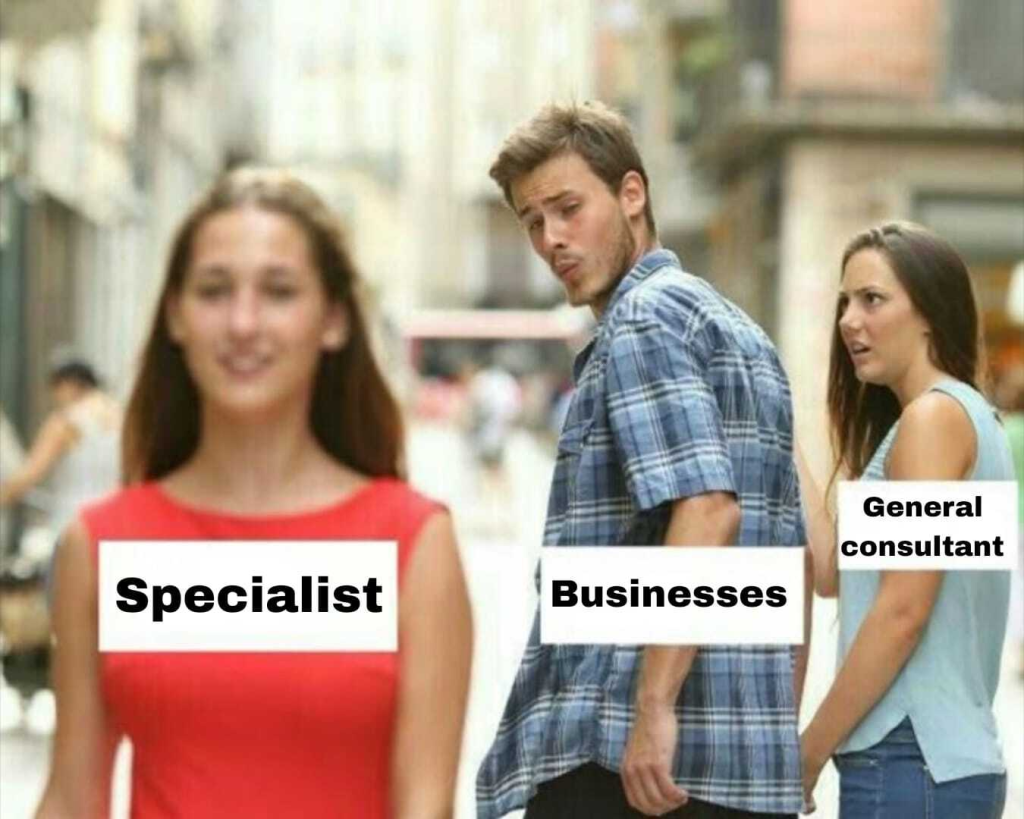
Your niche doesn’t have to be permanent, but it gives people a clear reason to remember you.
As your experience grows, you’ll naturally become more of a generalist because consulting exposes you to different industries, clients, and challenges. But early on, a niche gives you direction. It shapes what you learn, the projects you pursue, the people you network with, and ultimately how others see your expertise.
The importance of growing your network
At a certain point, breaking into ESG stops being just about what you know, and starts becoming about who knows what you can do.
This is where networking quietly becomes important.
ESG is still a field where a large number of roles and projects move through conversations before they ever become formal opportunities.
People refer candidates, recommend collaborators, and loop others into projects simply because they’ve interacted before or seen their work.
This is especially true in ESG consulting, where work is often project-based and trust matters as much as technical ability. A lot of early opportunities come from being visible in the right circles rather than waiting for the perfect job posting.
Over time, your network becomes less about finding opportunities and more about staying connected to how the industry is evolving.
Why platforms like Growth For Impact help?
As ESG careers grow more structured, platforms like Growt For Impact, can play a useful role in bridging the gap between learning and opportunity.
This kind of exposure is often missing when you’re only learning through courses or job descriptions.
For someone trying to break into ESG, especially consulting, this matters because it shows you how theory translates into real work. You start seeing how frameworks, tools, and domain knowledge actually come together in practice.
These platforms also quietly help with visibility. Engaging in community activities like reading, engaging, and occasionally contributing, can make it easier for opportunities to come to you rather than you constantly chasing them.
They don’t replace skills or experience. But they can make the path into ESG feel less disconnected and more grounded in what’s actually happening in the field.
Where you can find courses and jobs
But in case you are still eager about exploring courses in this domain, don’t fall into the cycle of doing one course after another. What matters more is whether you can apply what you are learning. If you’re still unsure, structured guidance can help you narrow things down.
Instead of randomly picking certifications, it’s more effective to match learning with your background and the niche you’re leaning toward, whether that’s reporting, climate risk, or consulting.
This is where tools like a course finder can be useful, helping you filter options based on your current skills, goals, and the direction you want to move in, rather than overwhelming yourself with everything available.
And when it comes to jobs, popular platforms are only one part of the picture.
A significant number of ESG and sustainability roles come through referrals, consulting networks, industry communities, and direct company outreach.
That’s why niche-building and networking matter, they directly influence what opportunities you even get access to.
Over time, the goal is not just to apply for roles, but to position yourself so that relevant opportunities start reaching you through the network and niche you’ve built.