
Find climate funding without the hassle- grants, accelerators, competitions & fellowships
Take a 3-minute quiz and get a ranked shortlist of grants, fellowships, competitions and accelerators that match your stage, region and sector. No more 100-tab grant hunts.
- 100+ programs tracked
- Updated monthly
- Free, no sign up
Hide the funding finder
Frequently Asked Questions
Practical answers for founders looking for grants, fellowships, and early-stage programs
Yes. A meaningful share of sustainability grants, fellowships, and student competitions are built specifically for pre-revenue or unincorporated teams - some even require you to be pre-seed.
The quiz flags which programs are realistic for your current stage. If your profile unlocks more options once you incorporate or join an incubator, that shows up in the results too.
A realistic rule of thumb: 10-40 hours for a serious application, including reviewing eligibility, writing the core narrative, preparing financials, and gathering supporting documents.
That is why shortlisting matters. Applying to three Strong Matches well almost always beats applying to ten Worth Exploring programs in a hurry.
Strong Match - your profile hits the known eligibility criteria cleanly. Start here.
Good Match - promising fit, but one or two criteria may need verifying on the official page.
Worth Exploring - enough overlap to investigate, but assume you will need to confirm key details before you invest time writing.
Most grants, fellowships, and prize competitions listed here are genuinely non-dilutive - no equity, no repayment. That is the whole point.
The trade-offs are usually reporting requirements, restricted use of funds, IP or open-source obligations, milestone-linked disbursements, or a commitment to publish results. Read the fine print on each program page before you commit.
Low match volume usually means one of three things: your region has fewer tracked programs, your stage is outside the most common windows, or your legal/entity status excludes you from a lot of the current database.
Often the fix is structural - lightweight incorporation, joining a local incubator, or sharpening how you frame your climate impact. Retake the quiz after any of those change.
We update the database regularly, but program deadlines, budgets, and eligibility rules can shift between updates. Treat this tool as your shortlisting layer, not the source of truth.
Always confirm the critical details - deadline, award size, eligibility, required documents - on the official program page before you start writing.
Start with Strong Matches that have near-term deadlines - those are your fastest wins. After that, work through Strong Matches with longer timelines, then the best Good Matches.
A simple working rule: commit to three to five applications you can do well, rather than starting ten you will never finish.
How the finder works

1. Tell us about your venture
14 questions covering region, stage, sector, team and the kind of support you want. Multi-select where it matters. Takes 3 minutes.

2. We score every programme against your profile
The engine runs each of the 90+ programmes through a real eligibility check- not vibes or a popularity ranking.

3. See your shortlist, ranked
Grouped by match status (good fit / partial fit / not now), with deadlines flagged and one-line ‘why this matched you’ notes.
What you'll see at the end
- A ranked shortlist- not a dump of links. Sorted by best match, with deadlines you need to act on this quarter.
- A ‘why this matched’ line on every result- so you can prioritise instantly.
- A ‘partial fit’ tier- programmes you don't qualify for today but should keep on your radar.
- A downloadable PDF report- optional. Useful if you want to discuss with a co-founder, mentor or advisor.

10 programmes from the database you'll recognise
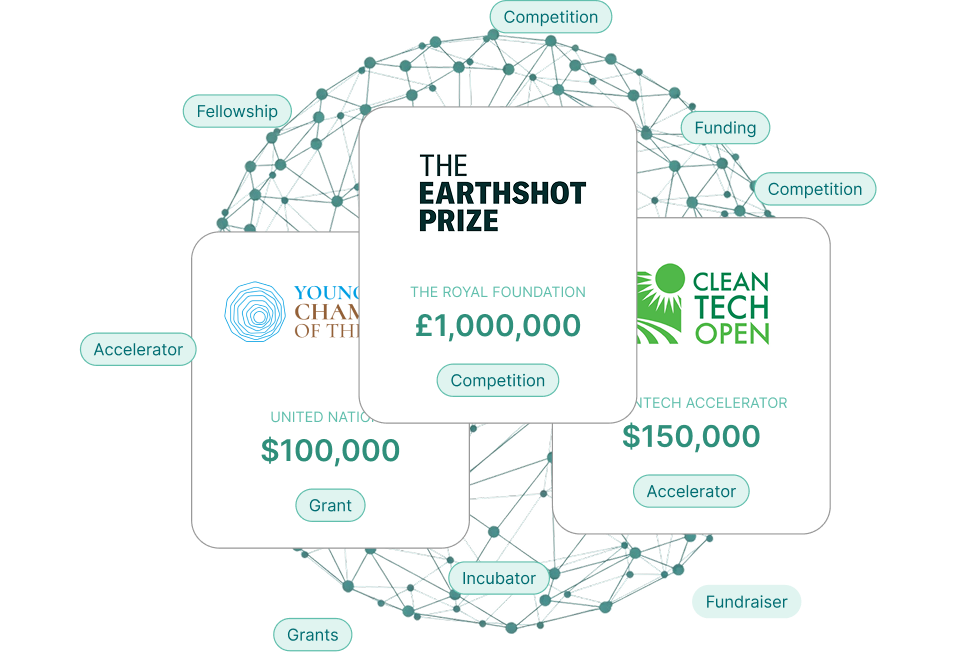
The finder matches you against several more. Here are ten of the most globally recognised programmes inside it- spanning fellowships, prizes, accelerators and grants- to give you a feel for the kind of money on the table.
| Programme | Type | Award | Next deadline | Apply |
|---|---|---|---|---|
| Earthshot Prize Royal Foundation | Competition | £1M per winner (5 winners/yr) | Nomination-based | Visit → |
| MIT Solve MIT | Competition | $100K+ per winner (10 winners) + partner prizes to $150K | May 21, 2026 | Visit → |
| Zayed Sustainability Prize UAE | Competition | $1M per category winner · $7.2M total pool | ~June 15, 2026 (2027 cycle) | Visit → |
| Hult Prize For current students | Competition | $1M grand prize | Fall 2026 registration | Visit → |
| UNEP Young Champions of the Earth UN Environment Programme | Grant | $10K seed + up to $100K Planet A grant | Feb 2027 expected (2026 closed) | Visit → |
| Breakthrough Energy Fellows Bill Gates / Breakthrough Energy | Fellowship | $500K – $3M per project · zero equity | November 2026 (Cohort 7) | Visit → |
| Activate Fellowship US national labs network | Fellowship | $300K+ over 2 years · zero equity | October 2026 (2027 cohort) | Visit → |
| Echoing Green Fellowship Since 1987 | Fellowship | Up to $100K over 18 months | Jul–Oct 2026 (2027 cohort) | Visit → |
| Cleantech Open Flagship US cleantech accelerator | Accelerator | Up to $150K in prizes · $50K via SAFE note | Feb–Apr (annual) | Visit → |
| ClimateLaunchpad EIT Climate-KIC · biggest green business competition | Competition | Global Top-8 cash prizes + free coaching | ~May 2026 (country-specific) | Visit → |
These are just 10 samples. The finder runs your profile against every programme- including country-specific schemes, sector-specialist accelerators, and rolling-application grants you'd never find by scrolling Google.
3 minutes · 14 questions · free, no signup to see results
Four types of non-dilutive climate funding- and when each fits
Grants
Money you don't pay back and don't trade equity for. Usually tied to a specific use of funds. Best for early-stage ventures where revenue is too small for an equity round. Trade-off: applications take real time; most have use restrictions and reporting. Examples: Global Innovation Fund, GEF Small Grants, BIRAC BIG Grant.
Fellowships
A personal stipend plus structured mentorship and a peer cohort. You- the founder- are funded, not the company. Best for solo founders or 2-person teams who need both runway and community. Trade-off: 6–24 month commitment with required programming. Examples: Echoing Green, Halcyon Climate, Activate.
Competitions and prizes
Lump-sum prize money plus exposure, triggered by a pitch event. Best for ventures with a sharp story and something to demo. Trade-off: only winners get cash; heavily judged on pitch quality. Examples: Earthshot Prize, MIT Solve, Hult Prize, Keeling Curve Prize.
Accelerators
Cohort programmes bundling cash, mentorship, network and sometimes lab access- with/without taking equity. Different from the typical Y Combinator-style equity accelerator. Best for prototype-to-pilot ventures. Trade-off: time-intensive; often requires travel. Examples: Cleantech Open, Free Electrons, ClimateLaunchpad, Third Derivative.
Climate funding by region
India
India has the deepest government-grant ecosystem for climate start-ups outside of the EU and US, plus a growing crop of state-level programmes. Eight India-specific programmes are in the finder, including a few that require Tier-II/III city base or TBI affiliation- both worth knowing about because they’re easy to arrange and unlock material grant pools.
Featured: MeitY TIDE 2.0, DST NIDHI-EIR, BIRAC BIG Grant, Startup India Seed Fund, Kerala Startup Mission, Karnataka ELEVATE.
Sub-Saharan Africa
The SSA climate-funding stack is anchored by adaptation-focused grants and Africa-specific accelerators. Several global programmes also explicitly prioritise SSA founders.
Featured: YouthADAPT Challenge, GSMA Innovation Fund, AEDIB Joint Innovation Facility, AFCIA, Catalyst Fund Climate Resilience.
Europe
European founders have access to the densest non-dilutive ecosystem, between EIT Climate-KIC, Carbon13’s venture-builder model, sector-specific competitions and women-founder-focused EU programmes.
Featured: Green Alley Award, Women TechEU, ClimateLaunchpad, Carbon13, Cambridge Climate Challenge, EKOenergy Climate Fund.
United States
Strong on accelerators and fellowships- both deep-tech (Activate, Breakthrough Energy Fellows) and platform-stage (LACI, Elemental Excelerator). Several US-headquartered programmes accept global applicants- the finder flags which.
Featured: Activate Fellowship, Cleantech Open, LA Cleantech Incubator (LACI), Elemental Impact (Excelerator), Third Derivative (D3), BEAM Circular Bioeconomy.
Middle East & North Africa
Smaller programme count but high-value: the Zayed Sustainability Prize and several global competitions with strong MENA representation.
Featured: Zayed Sustainability Prize, MIT Solve, Earthshot Prize, Global Innovation Fund.
Other South / Southeast Asia
Singapore anchors most of the regional non-dilutive activity (Liveability Challenge, Free Electrons), with global programmes increasingly courting SEA applicants.
Featured: Liveability Challenge, Free Electrons, New Energy Challenge, ClimateLaunchpad (regional rounds), UNIDO GCIP.
Latin America
Coverage is led by P4G Partnerships, Catalyst Fund’s resilience track, and global programmes with active LATAM cohorts.
Featured: P4G Partnerships, Catalyst Fund Climate Resilience, Global Innovation Fund, ClimateLaunchpad, Earthshot Prize.
Global / Open to all regions
About a third of the database is region-agnostic- these are the easiest to scan first if you’re based somewhere not specifically called out above.
Featured: MIT Solve, Earthshot Prize, Keeling Curve Prize, XPRIZE, Frontier Climate (Stripe), Bezos Earth Fund AI Challenge, Climate Change AI Grants.
By stage
- Idea / pre-MVP: ~22 programmes accept idea-stage founders. Start with: BIRAC BIG, Kerala SUM Idea Grant, MIT Solve, ClimateLaunchpad, Hult Prize (if you're a student).
- Prototype / MVP: Widest pool- ~50 programmes. Add: Global Innovation Fund, Cleantech Open, Free Electrons, Imagine H2O, Carbon13.
- Launched (some revenue): Earthshot Prize, Elemental Impact, LACI, Third Derivative, P4G Partnerships, NABARD NAFCC.
- Scaling: Frontier Climate (Stripe), GCF Project Preparation, Bezos Earth Fund, Trellis Climate Tech to Watch.
By sector
- Renewable energy / clean tech: SET Award, New Energy Challenge, Free Electrons, Cleantech Open.
- Circular economy / waste: Green Alley Award, BEAM Circular Bioeconomy, Sustainability Open Innovation.
- Agri / food / biotech: World Food Prize Innovate, Food Planet Prize, BIRAC BIG.
- Carbon removal / MRV: Frontier Climate, AirMiners Launchpad, XPRIZE.
- Water / oceans: Imagine H2O, XPRIZE Water Scarcity, Ocean Exchange.
- AI for climate: Climate Change AI Grants, Bezos Earth Fund AI Challenge, Google.org AI for Science, Klarna AI for Climate Resilience.
- Mobility / transport: Earthshot Prize, MIT Solve.
- Adaptation / resilience: AFCIA, YouthADAPT, Catalyst Fund, NABARD NAFCC.
Frequently Asked Questions
Practical answers for founders looking for grants, fellowships, and early-stage programs
Yes. A meaningful share of sustainability grants, fellowships, and student competitions are built specifically for pre-revenue or unincorporated teams - some even require you to be pre-seed.
The quiz flags which programs are realistic for your current stage. If your profile unlocks more options once you incorporate or join an incubator, that shows up in the results too.
A realistic rule of thumb: 10-40 hours for a serious application, including reviewing eligibility, writing the core narrative, preparing financials, and gathering supporting documents.
That is why shortlisting matters. Applying to three Strong Matches well almost always beats applying to ten Worth Exploring programs in a hurry.
Strong Match - your profile hits the known eligibility criteria cleanly. Start here.
Good Match - promising fit, but one or two criteria may need verifying on the official page.
Worth Exploring - enough overlap to investigate, but assume you will need to confirm key details before you invest time writing.
Most grants, fellowships, and prize competitions listed here are genuinely non-dilutive - no equity, no repayment. That is the whole point.
The trade-offs are usually reporting requirements, restricted use of funds, IP or open-source obligations, milestone-linked disbursements, or a commitment to publish results. Read the fine print on each program page before you commit.
Low match volume usually means one of three things: your region has fewer tracked programs, your stage is outside the most common windows, or your legal/entity status excludes you from a lot of the current database.
Often the fix is structural - lightweight incorporation, joining a local incubator, or sharpening how you frame your climate impact. Retake the quiz after any of those change.
We update the database regularly, but program deadlines, budgets, and eligibility rules can shift between updates. Treat this tool as your shortlisting layer, not the source of truth.
Always confirm the critical details - deadline, award size, eligibility, required documents - on the official program page before you start writing.
Start with Strong Matches that have near-term deadlines - those are your fastest wins. After that, work through Strong Matches with longer timelines, then the best Good Matches.
A simple working rule: commit to three to five applications you can do well, rather than starting ten you will never finish.
Once you've got the funding, two more questions you'll hit
ESG Reporting Requirements
Find out which ESG regulations apply to your company- CSRD, CSDDD, SB 253, SEBI BRSR and 10+ more. Free 5-minute check.
ESG Assurance Readiness
ISSA 5000 takes effect Dec 15, 2026. Find out where you are on the readiness curve and what to fix first.
Want a second pair of eyes on your application?
Growth For Impact helps start-ups with grant strategy sessions and writes/edits applications. If you’ve found 3+ programmes you’re a fit for and need help prioritising or sharpening your narrative, book a free 20-minute call.
How we maintain this database
Every programme in this finder is reviewed against its official source page at least once a month. We track: amount, deadline window, eligibility (age, stage, region, sector, registration), and any structural changes (track additions, programme pauses, discontinuations). The matching engine runs all programmes against 14 founder-profile dimensions.
Last database refresh: September 2026
Coverage: 100+ programmes across 8 regions and 10 sectors.
Disclaimer: This is a matching tool, not legal or financial advice. Always confirm current eligibility on each programme’s official page before applying.