
An honest guide to finding the right sustainability architect for your dream green home
If you’re here, you’re probably already convinced you want a sustainable home. You’re not asking if it matters, you’re trying to figure out how to actually do it right. And somewhere along the way, you’ve come across the term “sustainability architect.”
The tricky part? Everyone seems to define that differently. And when you’re making decisions that will shape how your home performs for decades, vague answers aren’t good enough.
The reality is that most mistakes don’t look like mistakes at the beginning. They show up later, in higher bills, uncomfortable spaces, and small daily frustrations that add up over time.
This guide is here to help you avoid that.
What does a dream sustainable home actually look like?
Before we get into how to find the right person, figuring out what actually you’re aiming for helps. Because “sustainable home” can mean a lot of things depending on who’s selling it to you.
A well designed sustainable home should actually deliver the following, in real, day-to-day terms:
Energy savings
Your bills don’t creep up year after year. The home is designed to use less from the start, instead of depending on costly systems to make up for bad design.
Water savings
Rainwater harvesting, efficient plumbing, and smart landscaping mean you’re not wasteful by default.
Feels more healthy
With better air circulation, natural light, less humidity and non-toxic materials, the home feels genuinely good to be in and not just aesthetically nice (which of course is important as well).
This kind of home doesn’t just happen by accident. So, who’s behind it?
Sustainability architects. They are not simply someone who designs a contemporary home and incorporates greenery as an afterthought. Their role goes beyond the Pinterest layer. They build the invisible logic behind every comfortable day.
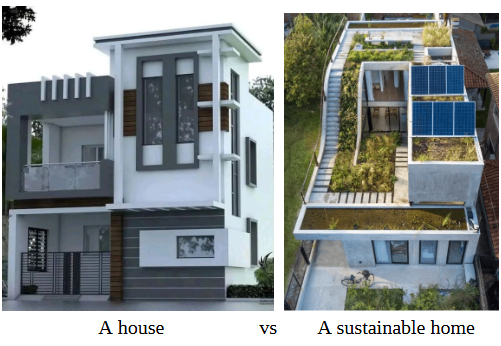
Interestingly, many homeowners only realize the importance of this after they’ve already built their house and started noticing problems they didn’t expect.
“As soon as we moved in a few months ago, I noticed pretty immediately that there was zero airflow in the home. My room and the entire level get VERY humid.”
– One homeowner recounted their experience on Reddit
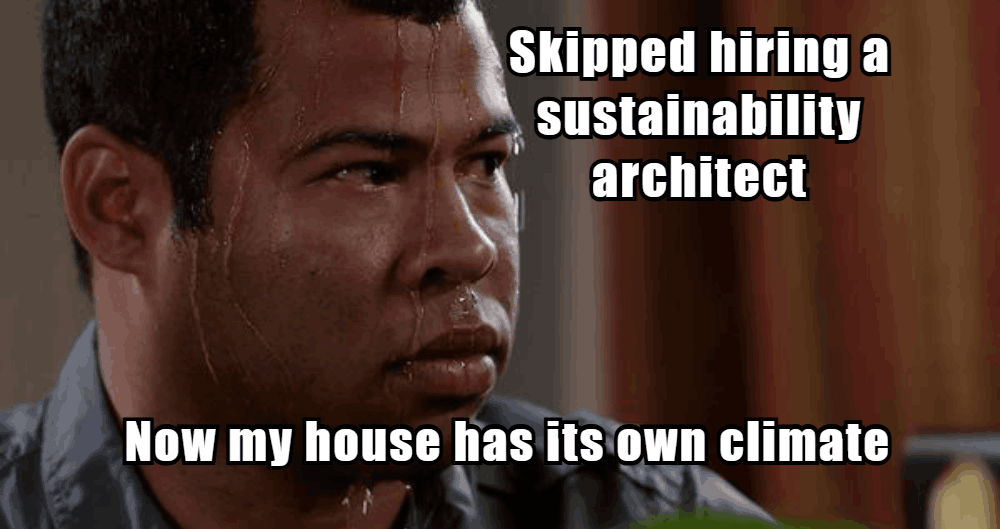
Why this choice matters (The real cost of getting the wrong architect)
This part doesn’t get talked about enough. Hiring the wrong person isn’t just a design disappointment but also financial one that adds up over time.
Think about it this way. If your home wasn’t designed with passive cooling in mind, your AC runs longer. Every month. For the entire life of your home.
And retrofitting? It can be painful. Fixing poor orientation means structural changes. Fixing inadequate insulation means opening up walls. None of that is cheap, and most of it is avoidable.
The homeowners who feel this most acutely are the ones who prioritized upfront savings on the architect and ended up spending multiples of that on fixes, systems, and ongoing energy costs.
“I was thinking of ways to make the home I build more sustainable. I want to do things like green roofs, water harvesters, and implementing more renewable materials, and low – no carbon concrete where I can.”
– One homeowner, reflecting on their build, shared on Reddit

Figuring the right architect for your home
Hiring a sustainability architect can be tricky. It is like choosing a long-term collaborator.
Credentials help
Look for architects with specific sustainability certifications like LEED, GRIHA, IGBC etc. since they signal that the architect has been formally trained to think about energy performance, not just aesthetics. It is important that the architect understands how their designs perform against established sustainability frameworks. Whether it’s net-zero energy targets, or WELL building standards, they should be fluent in at least one and able to explain how it translates to your home.
Material knowledge
A good sustainability architect knows their materials deeply. They know what performs well. They should be able to tell you why they’d choose rammed earth over AAC blocks for your context, or why a particular insulation material suits your climate. If they can’t get specific, that’s a signal.

Local material and climate knowledge
This one is extremely underrated. An architect who understands your specific region like its rainfall patterns, sun angles, dominant wind directions, and available local materials, will design something that genuinely works where you live.
The “Don’t get fooled” cheat sheet
When interviewing architects, use these questions to filter.
| Question to ask | Green flags | Bluff responses |
| “How will this design handle my local climate?” | Discusses sun paths, wind direction, and thermal mass. | “We’ll install a high-end HVAC system.” or “Don’t worry, we’ll just install solar” |
| “Can you show me a project that saved on energy bills?” | Explains specific design choices (e.g., window placement). | “Our clients save a lot on electricity using solar.” |
| “How do you minimize embodied carbon?” | Mentions local materials or specific structural choices. | “We use certified eco-friendly materials.” |
| “What is the biggest design mistake people make?” | Points to layout, orientation, or over-building. | “Not picking the right finishes/decor.” |
| “How do you handle budget trade-offs?” | “I prioritize insulation over expensive tech or while the budget might go over, but it’ll pay in recurring energy savings” | “Well, there are ways we can discuss later.” |
| “How do you decide what tech is necessary?” | “We design to minimize the need for machines first.” | “We can add smart home tech based on your requirements.” |

Where to actually find a good sustainability architect
Knowing what to look for is one thing. Knowing where to look is another. Here are a few reliable places to start:
- Word of mouth : If you know someone who built a home you admire, ask who designed it. Real referrals from real homeowners are worth more than any portfolio.
- Linkedin/Instagram searches: Several architects have very well crafted aesthetic pages.
- Google/AI tools- can recommend the most premium architects with the high brand presence. Though sometimes this comes with the risks of fraud accounts as well.
Or if you are looking for pre-vetted sustainability architects within your city who have successful track record of building truly green homes you can schedule a meeting here. You will be recommended architects that’ll fit within your budget, with expertise you can rely on.
Understanding the basics (so you don’t get misled)
When you’re making decisions that affect how your home feels and how much you’ll spend over the years, even a basic understanding of a few concepts goes a long way. Otherwise, it’s really easy just to nod along when someone explains things without actually knowing what it means for you.
1. Operational vs embodied carbon
You’ll hear these terms a lot, and they sound more complicated than they are.
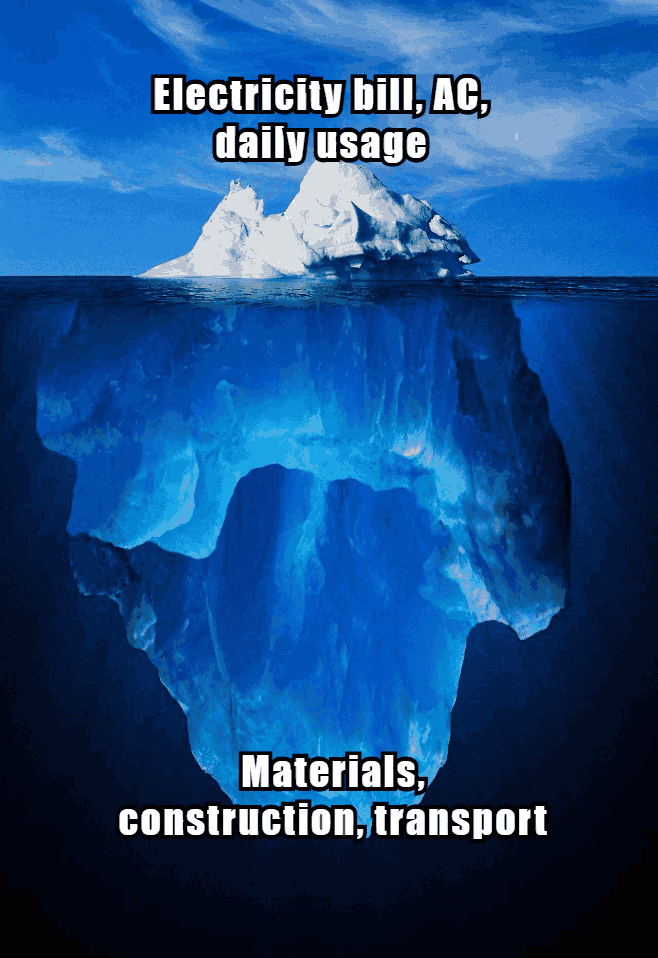
Operational carbon is what your home uses every day like electricity, cooling, heating, appliances. Embodied carbon is everything that went into building your home like materials, transport, construction. Most people focus on operational carbon because it’s visible. You see the electricity bill, you feel the AC running. But embodied carbon? That’s already locked in from day one.
2. Passive vs active design strategies
This one’s actually really intuitive once you see it. Passive design means your home itself does the work. Things like airflow, sunlight, shading, insulation. Active design is when machines step in like ACs, mechanical ventilation, solar panels. The best homes? They get the passive part right first.
Because when that’s ignored, people usually end up compensating with more and more tech, which just adds cost, maintenance, and complexity.

3. Balancing sustainability trade-offs
This is the part no one really talks about. Sustainability isn’t about doing everything perfectly.
It’s about making smart trade-offs. Some eco-friendly choices are expensive. Some budget-friendly choices aren’t the most sustainable. And that’s okay.
The goal isn’t to optimize every single thing. It’s to figure out what actually matters for you. A good architect helps you make those calls clearly, instead of overwhelming you with options or treating everything like it’s equally important.
“The lack of understanding of what value an architect provides is the answer”
– A user on Reddit
And honestly, that clarity is what saves you the most stress (and money) in the long run.
What to prioritize if you’re on a budget
When money is limited, ignore the shiny add-ons and invest every cent into these “Budget hero” fundamentals :
- Sun Positioning : Placing windows correctly costs zero extra money. Get it right, and you get free light and warmth. Get it wrong, and your house becomes a summer oven or a winter freezer.
- Natural Airflow : If your floor plan doesn’t allow for a cross-breeze, you’re stuck living in a box. A pro architect knows how to align openings so you can keep the AC off and let the wind do the work.
- Thermal Mass : Using dense materials like brick or stone where the sun hits is genius. They soak up heat during the day and release it at night, giving you free, consistent temperature control.
“ As architect the heating/cooling/electric side is ‘only’ a part of our area….next to design, legal, technical and budget stuff.”
– An industry peer on Reddit shared

A great sustainability architect knows that the best green home is built on smart design, not a massive shopping list. If they can’t make it work within your budget, keep looking, your future bank account will thank you.
“Sustainable isn’t ‘add more tech,’ it’s ‘remove waste.’ Most comfort problems come from design, not lack of gadgets.”
-One discussion in a home building discussion pointed out
Final thoughts: choosing long-term value over short-term savings
At the end of the day, choosing a sustainability architect is about how your space will feel to live in, every single day.
It decides whether your home feels easy or exhausting. Most people don’t regret spending a bit more on getting the design right. The real regrets usually come from the “it’ll be fine” decisions that are very much not fine later and way harder (and more expensive) to fix.

The question isn’t whether it’s worth it. It’s about choosing between living with small, everyday frustrations or creating a space that just works from day one.