
Which ESG regulations actually apply to your company?
CSRD, CSDDD, California SB 253, UK SECR, ISSB, SEBI BRSR- the list keeps growing, and the requirements keep changing.
Stop second guessing which ESG regulations apply to you with a 3 minutes quiz that answers which regulations apply to you, which don’t and which to keep an eye on.
10+ major frameworks
100% anonymity
Free, no signup

Hide the assessment
ESG Compliance Risk Assessment
Discover which sustainability regulations apply to your business in 3 minutes
How the assessment works
1. Tell us about your company
Which jurisdictions you operate in, company size, listing status and sector.
2. We cross-check every framework
CSRD, CSDDD, California SB 253, UK SECR, ISSB, SEBI BRSR and more- we cross-check the requirements.
3. Get your compliance map
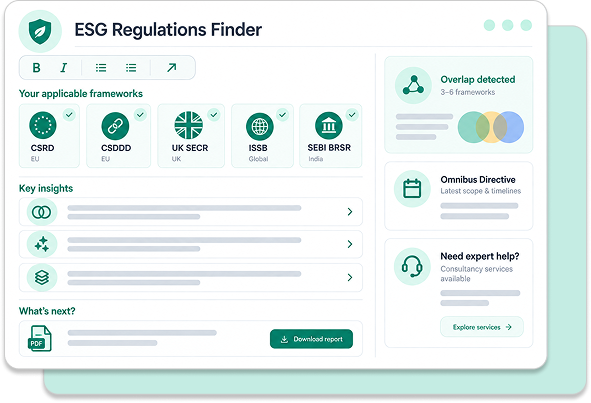
Every framework labelled Highly Probable, May Apply or Monitor Changes, organised jurisdiction by jurisdiction.
What the labels actually mean
Highly Probable
Your profile clearly clears the adopted thresholds and scope triggers for that framework. Focus on these first.
May Apply
One or more criteria depend on interpretation, listing status, supply-chain relationships, or pending enforcement guidance.
Monitor Changes
These don't apply to you today, but could on a foreseeable timeline- should track rather than act on them.
Covers multi-jurisdiction complexity
- Overlap flagged automatically- companies in 4 jurisdictions trigger 3-6 overlapping frameworks that all want similar climate data and governance documentation.
- Organised results, not four projects- the results are organised to help you design a single control set that feeds every framework you're exposed to.
- Reflects the Omnibus Directive- CSRD scope, CSDDD due-diligence boundaries and assurance timelines all reflect the new changes.
- A downloadable PDF report-that can be easily shared with your team. Additional consultancy services are also available.
Frequently Asked Questions
Everything you need to know about ESG regulations and this assessment tool
Who is this assessment designed for?
Sustainability leads, compliance officers, legal teams, finance teams, and investor relations staff at mid-to-large companies who need to know which ESG reporting and due diligence rules apply - without spending weeks mapping every regulation themselves.
If you're on an ESG-adjacent team and the phrase "is CSRD still in scope for us after Omnibus?" sounds familiar, this tool is for you.
How accurate are "Highly Probable" and "May Apply" labels?
Highly Probable means your profile clearly clears the adopted thresholds and scope triggers for that framework. May Apply means one or more criteria depend on interpretation, listing status, supply-chain relationships, or pending enforcement guidance. Monitor Changes means the rule doesn't apply today but could on a foreseeable timeline.
Treat this as a shortlisting tool, not a legal opinion. Every "Highly Probable" result should still be confirmed with counsel before you build reporting processes around it.
Our company operates in 4 jurisdictions. How do I avoid duplicating compliance work?
This is the single most valuable use case for the tool. Multi-jurisdiction companies typically trigger 3-6 overlapping frameworks (e.g. CSRD + California SB 253 + UK SECR + ISSB) that all demand similar climate data, supplier due diligence, and governance documentation.
The smartest move is to design one data architecture, one control set, and one governance cadence that feeds every framework - not four parallel projects. Use the jurisdiction sections in your results to identify the biggest overlaps first.
Is this up to date with the EU Omnibus Directive?
Yes. All EU framework thresholds (CSRD, CSDDD, Taxonomy) reflect the formally adopted Omnibus Directive from February 2026. That means CSRD scope is now 1,000+ employees AND €450M+ turnover, the limited-to-reasonable assurance transition has been removed, and CSDDD due diligence is now limited to direct business partners.
We update regulatory data monthly. Any threshold changes, new enforcement guidance, or scope narrowing gets incorporated within 30 days of confirmation.
What should we do first after running this assessment?
Pick your top 2-3 "Highly Probable" frameworks and run a formal threshold-validation exercise with counsel. That single step removes more uncertainty than anything else - and often reveals that at least one framework doesn't actually apply despite looking like it should.
Only after threshold validation should you spend on data systems, software, or reporting exercises. Building first and verifying later is the most common mistake we see teams make.
Does this replace legal or compliance advice?
No. This is a scoping and prioritization tool, not a legal opinion. Its purpose is to get your team past the blank-page problem and into productive conversations with counsel and internal stakeholders faster.
For any framework that looks material to your business, have qualified legal, compliance, or ESG specialists validate the applicability before you act on it.
Already know which ESG regulations apply to you? Check your assurance readiness next.
Knowing which frameworks apply is step one. Step two is knowing whether you’re actually ready for the assurance they require- and what needs to be fixed first.
How we maintain this assessment
We track threshold changes, new enforcement guidance and scope narrowing across every framework in the tool, and incorporate confirmed changes within 30 days.
Disclaimer: this is a scoping tool, not legal advice. Always confirm applicability of any framework with qualified counsel before acting on it.