

Meet Aarav.
Aarav is a student, who wants to help solve climate change. He wants his first job to be meaningful, and working in the climate sector seems like the right direction.
So, like most of us would, he starts searching:
“Climate jobs in India.”
And that is where the confusion begins.
He finds roles in sustainability, ESG, renewable energy, climate research, consulting, carbon accounting and environmental policy. Some require a degree in environmental science. Others ask for experience in finance, data analysis, communication or business.
Overwhelmed by the chaos, Aarav closes his laptop.
“But which one of these is actually a climate job?”
His problem is not necessarily that there are no opportunities. It is that he does not know what to look for, which skills matter, or where he fits into this growing sector.
Aarav is not alone in this situation.
For many students and professionals in India, entering the climate sector can feel like arriving at an airport with a ticket but no gate number. You have some idea of how you want the job to feel (hint- “Alfred, please bring my cape”), but finding the right itinerary is another challenge. When the attender asks you- “where to?”, you find yourself speechless.
So, let’s follow Aarav as he tries to figure it out.
What comes under a climate job?
Aarav realizes there isn’t a single path into the climate sector. Climate work cuts across industries, which means the roles can look very different depending on what part of climate action they contribute to.
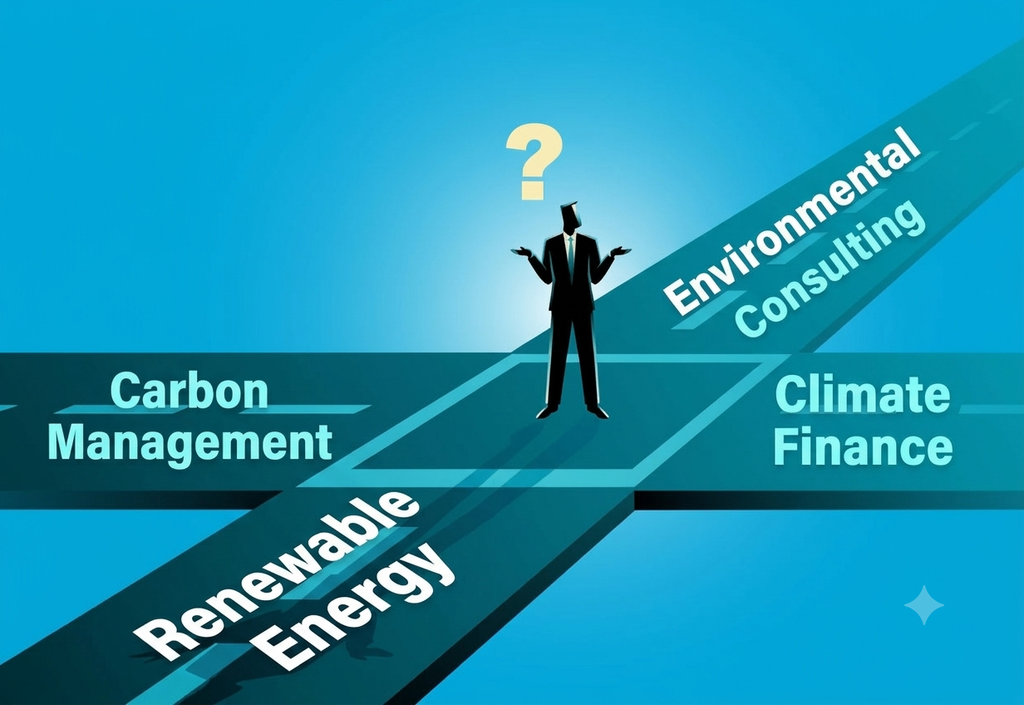
He comes across people working in renewable energy, carbon management, sustainability and ESG, climate research, environmental consulting, climate finance, policy and advocacy, and climate communication.
For Aarav, this changes the way he looks at the job market. He no longer needs to search only for jobs with “climate” in the title. Several other roles are also considered part of a climate career. With Project Drawdown’s declaration- “every job needs to be a climate job”, all hopes of finding your path seems doomed.
Climate change is arguably the biggest problem the world is facing today. Yet, why is it so difficult to find a well-paying job as a climate scientist? A climate professional trained in geospatial data and techniques, described on Reddit the struggle of finding relevant opportunities in India
If climate opportunities are spread across so many sectors and job titles, how does he know which ones are actually available in India?
The job market in India
Aarav knows that climate careers can take many forms. But when he starts looking for these opportunities in India, he runs into another problem: how big is the market actually?
“given how critical climate action is, the number of job opportunities seems disproportionately small.” – a young professional trying to build a career in the climate sector described a similar struggle on Reddit.
At first, Aarav feels the same way. Search for “climate jobs” and the results can seem limited, especially when compared with more established career fields.
But the picture becomes different when he looks beyond the word climate.
The climate sector is differentiated across several industries-
- Renewable energy companies need professionals working on clean-energy projects.
- Corporates are hiring for sustainability and ESG roles.
- Carbon management has created demand for professionals working on emissions measurement and reporting.
- Consulting firms, research organizations, NGOs and policy institutions also need people who can work on environmental and climate-related issues.
- There are newer opportunities emerging through climate-tech, sustainable finance, energy transition, adaptation and climate communication.
Instead, job seekers like Aarav will need to look for functional industry titles across corporate sustainability, carbon accounting, environmental consulting, and policy research.
Another issue here is that the market is not evenly distributed. Opportunities can vary depending on the sector, location, organization and level of experience. Some roles may be concentrated in larger companies, consulting firms, research institutions or climate-based organisations, while others in startups, NGOs and smaller organizations. A startup in Bengaluru might hire one person to handle everything from operations to carbon data, while a big firm in Mumbai has a 20-person team with narrow, specialized roles.
This points to another hurdle of experience.
Many entry-level climate roles still ask for skills or experience in areas such as research, data analysis, communication, finance, policy or project management.
For someone like Aarav, who is looking for a first job, this can make the entry point feel much narrower than the overall climate sector actually is.
So, is India lacking climate jobs?
Not necessarily.
The numbers suggest a more complicated picture.
India already has a growing climate-tech ecosystem. More than 800 operational climate-tech startups, with these companies raising over $3.6 billion between 2014 and 2024.
Tracxn data reported by The Economic Times counts 1,583 climate-tech companies, which have collectively raised $12.8 billion between 2008 and June 2026. The difference is largely because different studies use different definitions of what qualifies as a climate-tech company.
These numbers significantly change the way Aarav views the market.
India does not appear to have a climate job market that is simply “too small.” The bigger challenge is finding the right entry point into it.
And that leaves Aarav with his next question: If the opportunities are there, what does it actually take to get hired?
What makes you get hired?

Aarav has seen that the climate job market is broader than he first thought.
But another question comes up: if he doesn’t have a degree in environmental engineering or climate science, where does he fit in?
He starts looking more closely at different climate roles and realizes that the sector needs much more than people working directly with technology or environmental science.
Climate organizations also need analysts, writers, finance professionals, project managers, engineers, ESG consultants.
The skills and education required depend largely on Aarav’s skills, background, learning capabilities and exposure.
1. “I want to help big companies fix their impact” – Corporate ESG & Sustainability
If Aarav is interested in helping businesses reduce their environmental impact, corporate sustainability could be one path.
- Roles: ESG Analyst, Sustainability Analyst, Sustainability Associate, Supply Chain Associate
- What the work involves: Collecting and analyzing environmental data, supporting sustainability reports, tracking emissions, researching regulations and helping organizations meet sustainability requirements.
- Skills: Research, Excel and data analysis, report writing, understanding of ESG frameworks and environmental regulations.
A background in business, economics, management, environmental studies or related fields can be relevant here.
2. “I want fast-paced innovation” – Climate Tech & Startups
Aarav might want to find opportunities in climate-tech companies working on areas such as renewable energy, electric mobility, agriculture, carbon management or climate software.
- Roles: Climate Operations Analyst, Business Development Associate, Project Associate, Product Associate
- What the work involves: Supporting projects, researching markets, coordinating pilots, communicating with clients and helping new climate solutions reach users.
- Skills: Communication, research, project management, problem-solving and adaptability.
Here, a technical degree can be useful for certain roles, but it isn’t necessarily required for every position. Startups also value people who can work across different functions.
3. “I want to influence policy and drive community awareness” – Think Tanks & NGOs
For someone like Aarav who enjoys research, writing or policy, NGOs and research organizations can offer another route into climate work.
- Roles: Research Assistant, Policy Associate, Communications Associate, Project Coordinator
- What the work involves: Researching climate and environmental issues, preparing policy briefs, writing reports, supporting campaigns and coordinating projects.
- Skills: Research, writing, data interpretation, communication and an ability to understand complex policies.
Degrees in environmental studies, economics, public policy, political science, development studies and related fields for these roles help increase your odds. Beyond formal qualifications, showing a genuine passion for environmental advocacy, sustainability, and persuasive communication will often give you an edge.
4. “I want to follow capital gains” – Green Finance & Carbon Markets
Climate action needs financing. Banks, investment firms, impact funds and organizations need professionals who understand both finance and environmental issues.
- Roles: Impact Analyst, Sustainable Finance Associate, Carbon Analyst, Climate Risk Analyst
- What the work involves: Assessing climate-related risks, researching investments, analysing carbon projects and tracking developments in carbon markets.
- Skills: Financial analysis, data analysis, research and an understanding of carbon markets and climate-related financial risks.
A background in finance, economics, accounting or business can be particularly useful for these roles.
So, Is a Climate Degree Necessary?
Not always.
Some specialized roles, like LifeCycle Assessment or Carbon Accounting, particularly those involving climate science, engineering or technical environmental work may require specific academic qualifications. But many climate roles draw on skills that professionals may already have.
A finance professional doesn’t necessarily need to become a climate scientist to work in climate finance. A communications professional doesn’t need to become an engineer to work in climate communications.
The transition usually involves adding climate knowledge to an existing professional skill set.
That could mean learning about carbon accounting, ESG reporting, climate risk, renewable energy, environmental regulations, climate policy or another area relevant to the desired role.
For Aarav, this changes the question entirely. Instead of asking “What degree do I need to work in climate?”,
the question becomes: “What can I already do, and where does that skill fit into the climate sector?”
How can students and early career professionals start?
For Aarav, knowing which skills climate employers value is useful. But, how can he gain experience when most opportunities seem to ask for experience in the first place?
“I’m currently in my 1st year of BSc Environmental Science in India and honestly I feel really lost and anxious about my future. And I’ll be honest being from India sometimes feels like a disadvantage when trying to access global opportunities. There are fewer local opportunities in this field and even online it can feel harder to get visibility responses or mentorship compared to people in other regions of the world.” – A student on Reddit described a similar feeling.
For someone just starting out, the climate sector can feel difficult to navigate. But waiting for the “perfect” climate internship or job isn’t the only way to begin.
- Start with practical experience
Internships are an obvious starting point, but not the only option. Students and professionals can gain experience through research projects, volunteering, fellowships, university projects, NGO work, consulting projects and climate-focused organizations.The aim is to understand how climate work happens in practice. You can get started with this in 30-seconds here- growthforimpact
- Build proof of your skills
A CV can tell an employer that you have research or writing skills. A portfolio can show them. These projects don’t necessarily have to come from a formal job. They can be built independently or through academic and extracurricular work.
Depending on the career path, this could include:
- Climate research articles or policy briefs
- Carbon-footprint analysis
- ESG case studies
- Renewable energy market analysis
- Sustainability communication campaigns
- Data or GIS projects
- Climate-tech business cases
- Don’t limit your search to climate jobs
This is something Aarav has already learned while exploring the market. Instead of searching only for climate jobs, he can search for roles such as ESG Analyst, Sustainability Associate, Carbon Analyst, Energy Analyst, Climate Research Assistant, Environmental Consultant or Sustainability Communications Associate.
He can work within organizations where climate action is part of a broader business such as renewable-energy companies, consulting firms, banks, technology companies, NGOs, research institutions and sustainability teams.
- Build a network before you need a job
For someone entering a relatively specialized field, networking can help make the market easier to understand. Following climate professionals, joining relevant communities, attending webinars and conferences, reaching out to people working in areas of interest and finding mentors can help students learn what different roles actually involve.The goal isn’t to ask everyone for a job. It is to learn from people already doing the work. A great place to start with that is- opendoorclimate
- For professionals switching careers
The same approach can work for someone already in the workforce. A professional doesn’t necessarily need to abandon their existing career and start again. They can identify where their current skills overlap with climate roles and build the missing subject knowledge. The transition becomes less about starting over and more about connecting an existing skill set to a climate problem.
- Start Small, But Start Specifically
Aarav doesn’t need to figure out his entire climate career before applying for his first opportunity. He needs to choose an area that interests him, identify the skills it requires, gain some practical experience and create evidence of what he can do. This gives him something more useful than a vague goal of “working in climate”: a direction he can actually act on.
In the best-case scenario, you discover work you actually enjoy, build a helpful network, and gain valuable experience to show your next employer.
In the worst-case scenario, you spend a single month realizing it isn’t the right fit. Either way, the experience still counts.
.
The Future of climate careers in India and Globally
Now, you can understand what climate jobs can look like, what skills they require and how you can start building experience.
But one question still remains: Does the climate sector actually have a future?
The answer is becoming clearer as climate action increasingly influences energy, technology, finance, manufacturing and business.
Globally, renewable energy employment reached 16.6 million jobs in 2024, showing how the transition towards cleaner energy is already creating a large workforce.
However, the growth of employment will not come only from renewable energy. As economies transition, demand is also emerging around areas such as climate technology, energy efficiency, carbon management, sustainable finance and climate action risk.
What does this mean for India?
India’s clean-energy transition is expected to create significant employment opportunities over the coming years. A 2026 CEEW-NRDC study estimates that achieving India’s 500 GW non-fossil-fuel capacity target and goals under the National Green Hydrogen Mission could generate more than 4.4 million full-time-equivalent jobs.
The opportunity is not limited to technical roles either. Around 60% of clean-energy project deployment jobs are estimated to require highly skilled or semi-skilled workers, while manufacturing could require an even higher share of skilled workers.
This means that the future of climate careers will involve more than just engineers and environmental scientists.
But at the same time, the global climate job market will not grow evenly. The IRENA-ILO report notes that factors such as automation, economies of scale, supply-chain issues and geopolitical pressures affected renewable-energy employment growth in 2024.
For professionals, this means that simply choosing a “green” job may not be enough. The skills required by the sector will continue to change, making continuous learning and adaptability increasingly important.
Getting started
The search for a climate career often begins with a simple question: where are the jobs?
The answer reveals a rapidly expanding market with roles across renewable energy, sustainability strategy, carbon accounting, policy analysis, and climate-tech innovation.
Succeeding in this space doesn’t require reinventing your career. It starts with understanding where your transferable skills fit and acquiring the domain knowledge needed to make a meaningful contribution.
As India’s first climate job board, Growth For Impact is built to connect talented professionals directly with intent-driven opportunities across the green economy.
If you are ready to build your knowledge base, check out our climate and sustainability courses absolutely free of cost which can help you get started without a financial commitment.