
You run a manufacturing business that has started growing recently, orders are coming in and your business is expanding steadily. One day, a fellow business owner tells you how they were fined ₹5,000 a day for 94 days under SEBI’s LODR rules — about ₹4.7 lakh total penalty because they did not comply with ESG regulations. Suddenly, you are thinking: Could the same happen to my business?
In order to run a business, resources like water and electricity are required, waste is generated, employees and workers are involved in the process. But, these are all part of running a business and it comes with certain responsibilities.
Sometimes, the issue goes beyond these metrics. Certain requirements just get overlooked in day to day operations. To address these gaps, the Indian government introduced various ESG laws and Environmental regulations encouraging businesses to be transparent and accountable for their practices.
Following the right practices businesses can avoid hefty penalties, reduce risks and even attract new large businesses- because of the sustainability mandates by the EU and other international governments.
You may be wondering what different ESG terms mean, and why do they exist in the first place?
ESG regulations cover three areas broadly, environmental, social and governance factors that influence how businesses operate. While ESG sets the broader framework, Environment Compliance is the legal baseline here. It ensures that your business responsibly manages industrial waste, air and water emissions, limits its use of natural resources and secures essential legal approvals like Pollution Control Board’s Consent to Operate (CTO). In short, ESG provides a broader framework for responsible business practices across environmental, social and governance areas, while Environmental Compliance ensures that the operations remain legal and active.
“If you don’t measure it, you can’t change it.” A Reddit user commented on ESG reporting discussion.
ESG looks beyond immediate visibility and examines how the company operates in various areas.
A company’s labor record is a good example. Missed wages, unsafe conditions can signal real risk but none of that appears in a general web search.
But how do you figure which regulations apply to your business?

There are two companies: one is a textile company, while the other is a manufacturing unit, both with similar revenue, employees and labor practices.
Can similar regulations and environmental standards apply to both the businesses?
Not Always. Two businesses operate differently and have different impacts on the environment.
ESG reporting requirements are linked to a company’s listing status and market capabilities. For instance, SEBI mandates that top 1000 listed entities by market capitalization file a BRSR. However, this limited mandate also creates obligations on most unlisted MSME suppliers who are part of the large company’s supply chain and its related ecosystem. In most cases, these suppliers lack the data capacity to respond. In contrast, different environmental compliances depend on the nature of a company’s operations, resource consumption, waste generation and environmental impact- they aren’t just limited to top-1000 companies, but affect every business.
There is no universal checklist which can be applied in every case- but the applicability depends on the company’s operation and industry.
Still if you are eager to figure which ESG& environmental regulations affect your business,our ESG Regulation Quiz can help. 2 minutes, 15 questions, free of cost and no sign-up required. This quiz tool helps you identify exactly which regulations apply to your business, giving you a clear starting point without any guess work.
Why do ESG Regulations and Environmental Compliance matter?

S.D. Polymers, a registered plastic waste processor whose EPR certificates were found to be unsubstantiated.
Positioned itself as a leading recycling company and became the first Indian compounding firm to secure BIS certification for its PP polymer products. The company publicly highlighted its sustainability initiatives, including programs to empower rag pickers and promote circular economy practices.
However, during a joint audit by the Central Pollution Control Board (CPCB) and the Maharashtra Pollution Control Board (MPCB) in January 2024, regulators uncovered a critical compliance failure. The audit revealed that 81% of the company’s GST invoices for sales transactions were not uploaded to the EPR portal, despite a CPCB directive from December 2022 requiring this as mandatory proof for generating valid EPR certificates . Without these invoices, the certificates the company generated lacked verifiable proof that the claimed plastic waste processing actually correspondent to real sales.
This example clearly states why ESG compliance is necessary.
Many business owners are exhausted from the endless cycle of filings, approvals and regulatory updates. Instead of treating rules as a headache, businesses that are ahead of the curve, have been using these compliances as a competitive edge-
- A Kanpur auto-parts maker saved 18% on electricity bills and Rs.4 lakh annually through simple efficiency measures.
- Indian cement firms with better ESG scores get lower interest rates, longer tenures, and MSMEs can access SIDBI/IREDA loans at 50-100 basis points below commercial rates.
- SEBI’s BRSR required listed companies to report on suppliers covering 75% of purchases, vendors with ESG documentation are dropped from the shortlist.
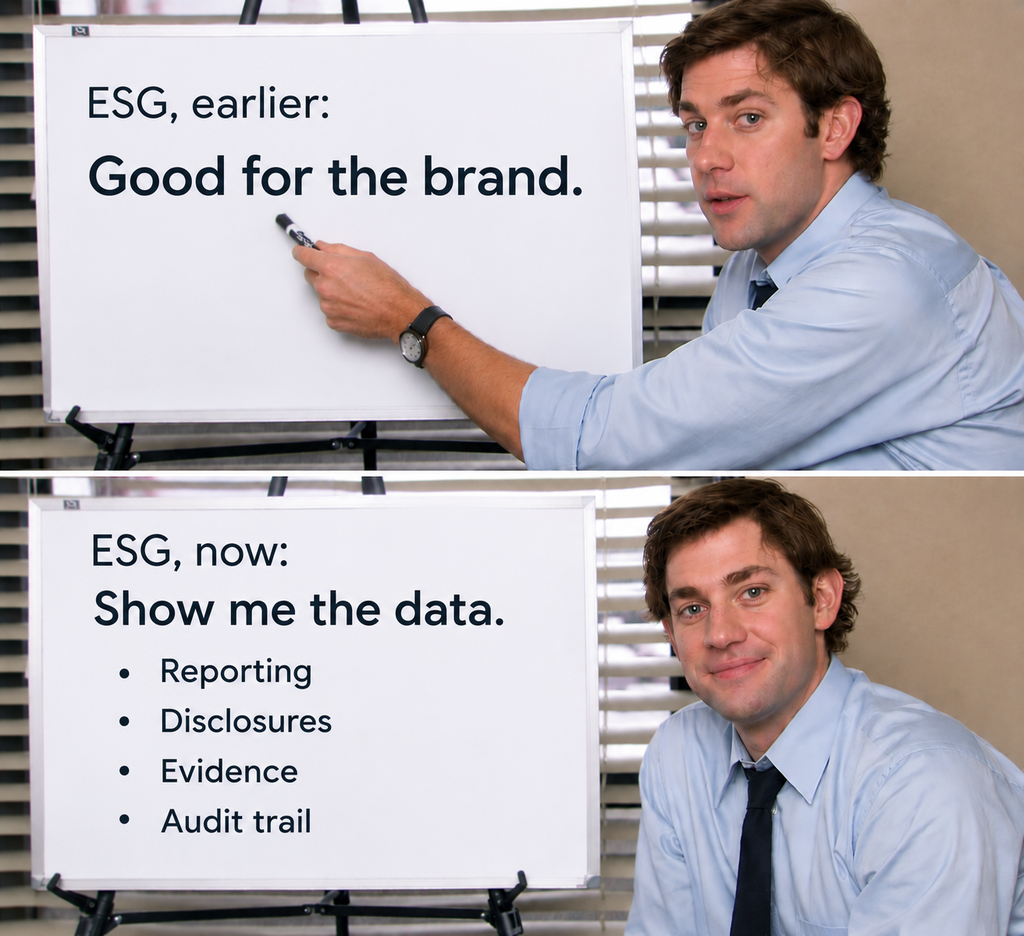
“ESG has shifted from a “nice-to-have” disclosure to a serious data and audit exercise.” A professional on Reddit highlighted the changing conversations in business circles.
This shift matters because it changes what ESG has historically meant for a business, the environmental, social, and governance requirements it must now address are evolving.
Key Areas of ESG Compliance in India
- Environmental Clearances
The sector specific statutes including, the Water (Prevention and Control of Pollution) Act,1974, Air (Prevention and Control of Pollution) Act, 1981 and Environment (Protection) Act, 1986 need to be strictly followed.
- Board Governance & Director Duties
Under the Companies Act, 2013, directors are legally bound to act in good faith and promote the interest of shareholders, employees, local communities, and the environment. Corporate boards must actively supervise sustainability initiatives, ESG committees, and consider environmental threats into strategic decisions.
- Mandatory CSR Spending
Under section 135(1) of the Companies Act, 2013, the companies that meet the prescribed financial thresholds must spend at least 2% of their average net profits from the immediately preceding three financial years on permissible CSR activities under Schedule VII.
- Labor Codes & Workplace Compliance
Companies need to ensure complete adherence to national workplace standards, non-discrimination policies, and worker protection measures under the Code on Social Security, 2020 and the Occupational Safety, Health and Working Conditions Code, 2020.
Consequences of overlooking compliance
Since India’s ESG framework is spread across different laws (both federal and state), regulations and reporting requirements, the consequences can depend on which requirement your business fails to comply with.
- Legal consequences
Environment obligations such as, Environment (Protection) Act, 1986, the Water (Prevention and Control of Pollution) Act, 1974, and the Air (Prevention and Control of Pollution) Act, 1981, Labor & Corporate governance. Failing to meet these criteria can expose the business to the consequences associated with particular law or regulation.
Ulhas and Waldhuni river pollution: In 2015, the NGT held several civic and industrial bodies responsible for pollution of the Ulhas River and directed them to contribute around ₹96 crore towards restoration. The matter later reached the Supreme Court, which directed the Maharashtra government to ensure ₹100 crore was made available for restoration of the rivers.
- Transparency & Disclosure Framework
ESG compliance is associated with how a business is perceived by the people who interact with it. Inaccurate disclosures or misleading claims can damage the company’s credibility.
Suzlon Energy: Rs.29 crore SEBI fine for financial misreporting.
- Business & Financial Risks
ESG implementation may require businesses to invest in data collect, monitoring systems, reporting, employee training, and external assurance. However, if the company does not have proper systems in place, it has to address these gaps later.
Poor environmental practices, unreliable data, or frail internal systems can make it harder for a business to identify and manage risks.
Pace Digitek: Rs.55.92 lakh penalty for failing to spend or transfer mandatory CSR funds across three years.
Foodstuffs: Rs.15.57 lakh for the same violation.
Ready to take the next step?
ESG regulation and Environmental compliance are becoming an essential part of doing business in India. From environmental responsibilities to employee welfare and transparency, businesses are expected to look beyond revenue and take accountability for its impact on the planet.
On the positive side, ESG compliance can be approached step by step by understanding the requirements that apply to your business, maintaining records, and addressing gaps.
This is where we help, by connecting you to the right ESG consultant who understands your industry and its nuances. Find an ESG expert within 48 hours, not 48 days.